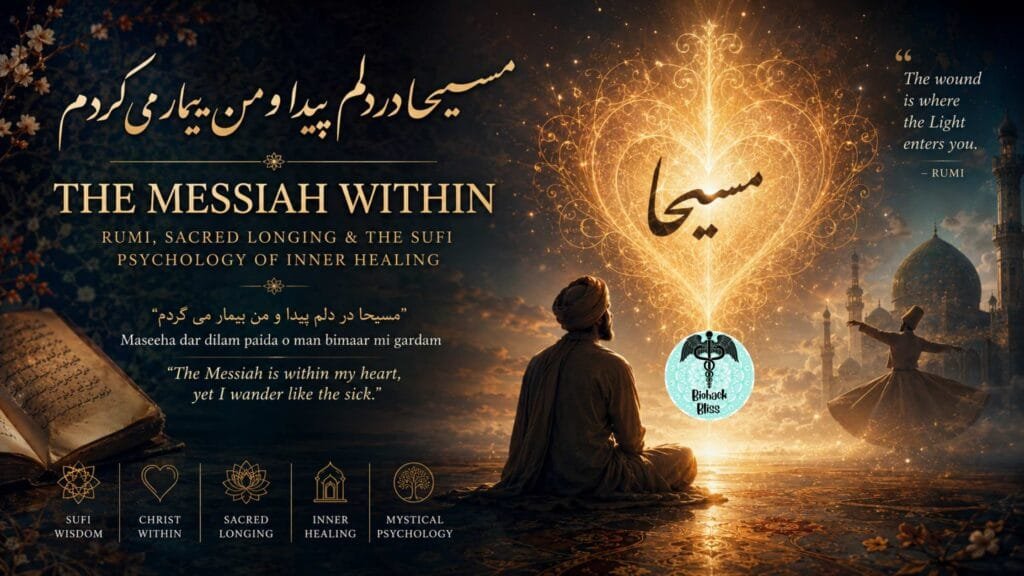
مسيحا در دلم پيدا و من بيمار می گردم
Maseeha dar dilam paida o man bimaar mi gardam
“The Messiah is within my heart, yet I wander like the sick.”
This Persian verse — widely circulated in mystical traditions and often associated with the spirit of Jalal al-Din Rumi — contains a paradox at the center of Sufi metaphysics:
the healer appears within the heart,
yet the self continues to suffer.
If the Messiah lives within,
why does the poet still wander in sickness?
But this contradiction is precisely what makes the verse deeply Sufi.
Because in mystical thought, awakening does not always arrive as comfort.
Sometimes it arrives as rupture.
Rumi Before Shams
Before becoming one of history’s greatest mystical poets, Jalal al-Din Rumi was already a respected Islamic scholar:
- a jurist,
- theologian,
- teacher,
- and intellectual authority.
Then came Shams of Tabriz.
According to Sufi tradition, Shams encountered Rumi surrounded by books and asked:
“What are you doing?”
Rumi reportedly replied:
“Something you cannot understand.”
Shams then threw the books into water.
Rumi rushed to save them — only to discover the pages were completely dry.
Shams responded:
“This too is something you cannot understand.”
Whether historically literal or symbolic, the story represents a turning point in mystical consciousness:
the collapse of intellectual certainty into direct experience.
The scholar dissolved.
The mystic emerged.
After Shams entered his life, Rumi’s poetry transformed into something radically different:
- ecstatic,
- grief-stricken,
- intoxicating,
- filled with longing and sacred contradiction.
And it is within this atmosphere that the verse:
مسيحا در دلم پيدا و من بيمار می گردم
begins to make sense.
The Messiah in Sufi Symbolism
In Persian and Sufi poetry, the word:
مسيحا (Maseeha)
refers to Jesus Christ.
But not only historically.
Across centuries of Islamic mysticism, Jesus becomes symbolic of:
- divine breath,
- miraculous healing,
- resurrection,
- spiritual awakening,
- and the revival of dead hearts.
According to Islamic tradition, Jesus heals through the breath of God.
Sufi poets transformed this into a metaphysical symbol:
the divine breath already exists within the human soul.
Rumi & The Breath of Jesus
Jalal al-Din Rumi repeatedly invokes:
دمِ عیسی (Dam-e Isa)
— “the Breath of Jesus.”
One famous Rumi passage says:
از دمِ عیسی مدد میگیر دل
تا رهی از حبسِ تن ای مردِ دل
Translation:
“Seek help from the breath of Jesus, O heart,
so you may escape the prison of the body.”
Here, Jesus symbolizes:
- liberating consciousness,
- spiritual awakening,
- and the reviving force hidden within the soul.
The resurrection becomes inward.
Hafez & The Hidden Christic Potential Within Humans
Hafez pushes this symbolism even further:
فیض روح القدس ار باز مدد فرماید
دیگران هم بکنند آنچه مسیحا میکرد
Translation:
“If the grace of the Holy Spirit grants aid again,
others too may do what the Messiah once did.”
This is one of the clearest mystical suggestions in Persian poetry that the healing force associated with Christ is not entirely externalized.
The implication is profound:
the same sacred consciousness symbolized by the Messiah may awaken within human beings themselves.
Ibn Arabi & The Heart as Divine Mirror
Ibn Arabi wrote:
لقد صار قلبي قابلاً كل صورة
Laqad sara qalbi qabilan kulla surah
Translation:
“My heart has become capable of every form.”
He continues:
فمرعى لغزلان ودير لرهبان
“A pasture for gazelles and a monastery for monks.”
For Ibn Arabi, the awakened heart becomes:
- church,
- temple,
- sanctuary,
- mirror of divine manifestation.
Jesus, within Ibn Arabi’s symbolic universe, represents:
- spirit,
- sacred breath,
- divine imagination,
- awakened consciousness.
Attar & Resurrection Through Annihilation
Farid ud-Din Attar repeatedly frames awakening as symbolic death before rebirth.
In Conference of the Birds, he writes:
تا نگردی مرده زین جانِ خویش
زنده نگردی به جانانِ خویش
Translation:
“Until you die to this self of yours,
you will never awaken into the Beloved.”
This mirrors the deeper Sufi symbolism of resurrection:
the false self must collapse before spiritual life emerges.
The dead heart revives only after ego dissolution.
Ruzbihan Baqli & The Jesus of the Heart
Ruzbihan Baqli frequently describes the heart becoming illuminated through divine manifestation.
One mystical formulation associated with his teachings states:
عیسیِ دل مرده را زنده کند
Translation:
“The Jesus of the heart revives the dead.”
Again, resurrection becomes inward.
The miracle occurs within consciousness itself.
Jami & The Birth of Christ Within the Heart
Abdur Rahman Jami develops deeply esoteric symbolism comparing:
- the purified heart to Mary,
- divine inspiration to the Holy Spirit,
- and awakening to the birth of Christ within consciousness.
A verse attributed to Jami says:
چون مریمِ دل پاک شود از همه غیر
عیسی صفتی ز روح پیدا گردد
Translation:
“When the Mary of the heart is purified of all else,
a Christ-like spirit emerges from the soul.”
The symbolism is striking.
The heart becomes capable of manifesting sacred consciousness internally.
The Sacred Illness of Love
But the second half of the verse changes everything:
“…and I become sick.”
Why would the appearance of the Messiah create illness?
Because in Sufi poetry, divine love itself is often portrayed as a sacred sickness.
Love destabilizes.
It dismantles certainty.
It dissolves identity.
It fractures the illusion of separation.
This is why Persian mystical poetry repeatedly associates awakening with:
- longing,
- burning,
- exile,
- beautiful sorrow,
- and ecstatic disorientation.
The seeker becomes ill not despite divine love —
but because of it.
The Wound as the Doorway
One of the most famous lines associated with Rumi says:
“The wound is where the Light enters you.”
Whether literally authored by Rumi or emerging through later mystical transmission, the principle is deeply Sufi:
suffering can open consciousness.
Not because pain itself is holy —
but because rupture breaks illusion.
Grief softens identity.
Longing dismantles certainty.
The ego fractures,
and something deeper begins to emerge.
This is why Sufi poetry repeatedly returns to:
- heartbreak,
- exile,
- sacred longing,
- and beautiful sorrow.
The wound becomes the doorway.
Mysticism, Psychosis & Spiritual Emergency
Modern psychology has increasingly explored the overlap between:
- mystical experiences,
- altered states of consciousness,
- ego dissolution,
- trauma,
- and psychospiritual crisis.
Researchers in transpersonal psychology use the term:
spiritual emergency
to describe experiences where psychological breakdown and spiritual transformation may overlap.
Psychiatrist Stanislav Grof proposed that some crises traditionally labeled pathological may also involve:
- symbolic transformation,
- identity restructuring,
- and expanded states of consciousness.
Importantly:
this does not mean psychosis is enlightenment.
Classical Sufis themselves warned against confusing:
- genuine unveiling,
with - delusion,
ego inflation,
or imbalance.
Still, the parallels remain striking.
The Sufi archetype of the:
Majzoob
— one spiritually overwhelmed by divine attraction —
often resembles states modern psychology might interpret differently.
To society:
the majzoob appears irrational.
To the mystic:
they are consumed by overwhelming contact with the Real.
Healing, Ritual & the Nervous System
Modern neuroscience increasingly recognizes that healing is deeply connected to:
- nervous system regulation,
- contemplative states,
- emotional safety,
- breath,
- environment,
- ritual,
- and introspection.
For centuries, mystical traditions used:
- poetry,
- meditation,
- music,
- fragrance,
- herbs,
- fasting,
- and contemplative ritual
to cultivate states of stillness and transformation.
Not as escape —
but as reconnection.
At Shamanic Biohacker LLC. our philosophy exists within this broader exploration of consciousness, restoration, and inner balance.
Our Botanical Blend was never imagined as escapism.
Instead, it belongs to a modern ritual of slowing down:
- creating space,
- reconnecting with the body,
- restoring calm,
- and supporting reflection in an overstimulated world.
Because sometimes healing begins not by searching outside ourselves —
but by listening more carefully to what already exists within.





















Reviews
There are no reviews yet.