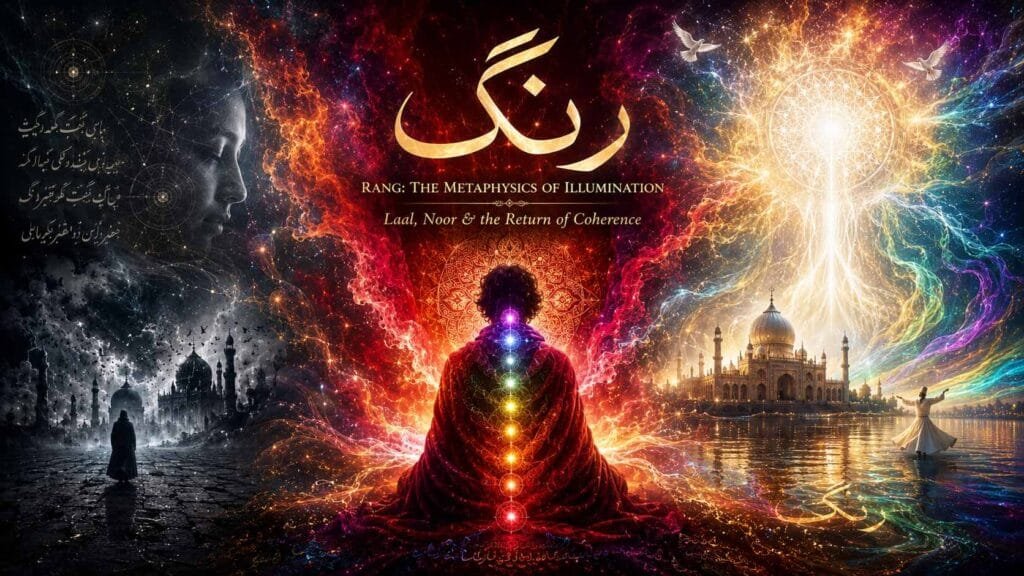
Laal, Noor & the Return of Coherence
Across:
Sufi poetry,
Punjabi kafis,
shamanic initiation traditions,
contemplative neuroscience,
and modern biofield research,
a recurring idea appears:
Human consciousness experiences transformation through the language of color.
Not merely symbolic color —
but lived states of:
luminosity,
darkness,
radiance,
vibration,
emotional saturation,
and presence.
In the famous qawwali “Aaj Rang Hai,” attributed to Amir Khusrau, the repeated cry:
“آج رنگ ہے اے ماں رنگ ہے ری”
“This day there is color, Mother! There is color!”
is not simply celebration.
It is the description of transformed consciousness itself.
The Sufis called this transformation:
“رنگ” — Rang.
A spiritual coloration of the soul.
Sibghat Allah — “The Dye of God”
The metaphysical root of “Rang” begins in the Qur’an:
“صِبْغَةَ ٱللَّٰهِ”
“The Dye/Color of God.”
— Qur’an 2:138
The Arabic word:
صبغة (sibgha)
literally means:
dye,
coloration,
immersion in color.
For the Sufis, the human being begins spiritually “colorless” — separated from deeper reality through:
ego,
fragmentation,
fear,
distraction,
and forgetfulness.
Then through:
love,
zikr,
music,
surrender,
remembrance,
and companionship,
the soul becomes “dyed.”
This is the deeper meaning behind the verses:
“جس کی چونر رنگ دے ساجن”
“Whoever’s veil the Beloved dyes…”
and:
“تورا رنگ من بھایو”
“Your color has overtaken my heart.”
The “color” is consciousness itself being transformed.
The Three States of Rang
Across mystical traditions, a remarkably similar structure repeatedly appears:
1. Separation — Colorlessness
2. Rang — Burning Transformation
3. Noor — Illumined Reintegration
STAGE I — COLORLESSNESS
“The world becomes gray before it becomes luminous.”
In Sufism, the unawakened condition is described as:
The seeker experiences existential emptiness.
A world without “Rang.”
Modern neuroscience describes something surprisingly similar in conditions involving perceptual dysregulation.
Research into schizophrenia spectrum disorders suggests altered consciousness can affect:
Patients may experience reality as:
Butler et al. (2008) – Visual perception impairment in schizophrenia
Javitt (2009) – Sensory processing in schizophrenia
The Sufis might describe this state as:
hijab — veiling.
A condition where consciousness loses coherence and connection to meaning.
Yet an important distinction remains essential:
Mysticism and psychosis are not the same thing.
Psychosis often fragments the self without reintegration.
Authentic mystical traditions seek:
Still, both suggest something profound:
Consciousness shapes the way reality itself is experienced.
Bulleh Shah & the Dissolving Self
Bulleh Shah writes:
“رنجھا رنجھا کردی نی میں آپے رنجھا ہوئی”
“Calling Ranjha again and again,
I myself became Ranjha.”
The separate self dissolves into what it loves.
Consciousness gradually takes on the “color” of its deepest attachment.
Muhammad Iqbal beautifully captured this ecstatic fluidity when he wrote:
“The butterfly imagination of the Persian flies half-inebriated as it were, from flower to flower…”
For Iqbal, Persian-Sufi consciousness was never rigidly analytical alone.
It was:
symbolic,
emotional,
luminous,
musical,
and experiential.
STAGE II — RANG
“The soul burns before it glows.”
In the Chishti Sufi tradition, transformation occurs through:
The seeker becomes “dyed.”
This is why “Aaj Rang Hai” repeats itself almost hypnotically:
“آج رنگ ہے”
“Today there is color.”
Modern neuroscience suggests rhythmic repetition, chanting, synchronized breathing, and emotionally resonant music can affect:
Freeman (2000) – Neurobiology of music and social bonding
Porges – Polyvagal Theory
This may explain why nearly every civilization independently developed:
sacred music,
chants,
poetry,
drums,
and rhythmic ritual
as technologies of consciousness transformation.
Perhaps this is also why modern consciousness-oriented wellness cultures increasingly revisit ancient questions the mystics were already exploring:
How does rhythm affect consciousness?
How does emotional coherence alter perception?
Can nervous system regulation change lived reality?
Can embodied practices restore meaning in fragmented times?
This intersection between ancient mysticism and modern biohacking increasingly informs emerging wellness cultures, including projects like Biohack Bliss.
Shah Hussain, “Laal” & Sacred Fire
Shah Hussain repeatedly invoked:
red garments,
dyed cloth,
bridal veils,
and ecstatic redness.
In Punjabi Sufi symbolism:
black represented annihilation and mystery,
white represented illumination,
but red — “Laal” — became the color of burning transformation itself.
This appears in the famous invocation:
“لال میری پت رکھیو”
“Protect my honor, O Red One.”
“Laal” here becomes:
the Beloved,
divine intoxication,
sacred fire,
transformative presence,
awakened consciousness.
The seeker must first burn before becoming luminous.
“Mera Piya Ghar Aaya” — Red as Illumination
One of the most fascinating symbolic inversions in Punjabi Sufi poetry appears in the verses of Bulleh Shah:
“میرا پیا گھر آیا، او لالنی”
“My Beloved has come home, O Red One!”
The “home” is not merely a house.
It becomes:
the heart,
consciousness,
the restored self.
The Beloved’s arrival marks:
And significantly:
the arrival is associated with:
“Laal.”
Not detached transcendence —
but living, embodied illumination.
Laal, the Spectrum & the Inverse Crown
Scientifically, red occupies a unique position in visible light:
At the opposite end lies violet:
Yet white light contains the entire visible spectrum unified together.
This becomes symbolically profound.
In many later yogic systems:
Yet ecstatic Punjabi Sufi symbolism often appears to invert this structure.
Here:
“Laal”
becomes the color of illumination itself.
Not primitive instinct —
but awakened fire after transformation.
Instead of transcending embodiment,
illumination descends into the heart.
The seeker does not abandon:
longing,
emotion,
embodiment,
passion,
or love.
These become sanctified.
Research into contemplative neuroscience suggests awareness-based practices can alter neural processing related to:
bodily awareness,
emotional integration,
and self-perception.
Farb et al. (2013) – Meditation and interoceptive awareness
This aligns remarkably with ecstatic Sufi portrayals of illumination as:
embodied,
emotionally alive,
relational,
and fully human.
Khudi, Kundalini & the Danger of Passive Illumination
Muhammad Iqbal was deeply aware of yogic metaphysics and the language of spiritual ascent present across the Indian intellectual tradition.
He engaged seriously with:
Yet Iqbal repeatedly warned that spirituality becomes dangerous when illumination is interpreted as withdrawal from life rather than intensified participation within it.
This is where his concept of:
Khudi — the awakened self
becomes central.
Many mystical systems describe ascent through:
Iqbal feared such ideas could become psychologically passive when misunderstood.
For him, the self was not an illusion to erase.
It was:
This is why Iqbal consistently emphasized:
baqa (reintegrated awakened existence)
over excessive interpretations of:
fana (self-annihilation).
The experience of:
appears across many traditions.
Yet different systems interpret these experiences differently.
Where some metaphysical systems sought dissolution into impersonal cosmic consciousness, Iqbal envisioned awakening as:
intensified individuality illuminated by Divine coherence.
In this sense, Iqbal’s metaphysics moves away from colorless transcendence toward embodied illumination.
“Rang” therefore becomes more than symbolic color.
It becomes:
This distinction becomes especially fascinating when compared with Carl Jung, who interpreted Kundalini symbolism psychologically rather than literally.
For Jung, the ascent through symbolic energetic centers represented:
individuation,
integration of consciousness,
confrontation with the unconscious,
and the gradual unification of the self.
In Jung’s interpretation, Kundalini was not merely occult physiology —
but a symbolic map of psychological transformation itself.
Carl Jung – The Psychology of Kundalini Yoga
Remarkably, this brings Jung unexpectedly close to aspects of both:
The goal is not annihilation into abstraction.
The goal is reintegrated luminosity.
Not escape from embodiment —
but transformed embodiment.
Sultan Bahoo & the Color of the Friend
Sultan Bahoo described the Divine Beloved as:
“رنگ رنگیلا یار”
“The Friend filled with colors.”
For Bahoo, transformation was inner alchemy.
The ego-self dissolves until the seeker reflects divine qualities like a polished mirror.
Sufi Aura & the Human Biofield
Classical Sufis repeatedly described spiritually transformed humans as radiating:
Modern physiology confirms that the:
heart,
brain,
muscles,
and nervous system
generate measurable electromagnetic activity.
Research from the HeartMath Institute suggests the heart generates a measurable electromagnetic field extending beyond the physical body, though broader metaphysical interpretations remain debated.
McCraty & Childre (2010) – Heart coherence research
This does not scientifically prove mystical rainbow “auras.”
But it raises an intriguing possibility:
Ancient mystical traditions may have been phenomenologically describing subtle dimensions of emotional and energetic presence long before modern scientific terminology existed.
Today, modern wellness and biohacking cultures increasingly explore similar intersections between:
Brands such as Biohack Bliss emerge precisely at this intersection:
between ancient experiential wisdom and modern exploration of human consciousness.
Iqbal, Unity & White Light
Muhammad Iqbal identified one of the deepest tendencies within Persian metaphysics as:
“Reality as Light.”
For Iqbal, Persian mystical thought continuously searched for:
“the inner unity of things.”
This pursuit of unity lies at the heart of:
Rang,
Noor,
fana,
and illumination.
Even physics offers a striking metaphor here:
White light is not the absence of color.
It is the integration of the entire visible spectrum.
Mystically, this becomes profound:
Fragmented consciousness experiences separated colors.
Integrated consciousness experiences unified light.
Iqbal further argued that Sufism emerged as:
“a necessary product of the play of various intellectual and moral forces which would necessarily awaken the slumbering soul to a higher ideal of life.”
This becomes deeply relevant in the modern age.
In a fragmented world increasingly marked by:
overstimulation,
emotional dysregulation,
alienation,
and loss of meaning,
the search for coherence, illumination, and embodied consciousness may itself represent a modern continuation of the ancient search for:
Rang.
STAGE III — NOOR
“White light is every color reconciled.”
In Sufism, the final state after “Rang” is:
The seeker does not disappear into madness.
The seeker becomes whole.
This is captured beautifully in the verse:
“ہم میں تم اور تم میں ہم گم ہو گئے”
“I lost myself in you and you lost yourself in me.”
Modern neuroscience has become increasingly interested in states where rigid self-boundaries soften.
Research involving meditation, mystical experience, and nondual awareness suggests reduced activity in brain regions associated with:
Carhart-Harris et al. (2014) – The entropic brain theory
Newberg & Waldman – How God Changes Your Brain
Subjects frequently report:
unity,
luminosity,
timelessness,
radiance,
and interconnectedness.
Again, this does not “prove” mystical theology.
But it suggests human consciousness naturally possesses states where separation itself becomes less dominant.
Rumi & Becoming Colorless
Jalal al-Din Rumi eventually resolves the paradox by speaking of becoming:
“colorless like water,
so you may take on every color.”
The ego first possesses its own rigid “color.”
Then divine love dyes the soul.
Finally, the self becomes transparent enough to reflect the entire spectrum.
The Return of Coherence
Perhaps this is why Punjabi Sufi poetry repeatedly associates healing not with escape from life —
but with the return of the Beloved into the heart:
“میرا پیا گھر آیا”
“My Beloved has come home.”
Consciousness becomes inhabited again.
Perhaps the modern wellness movement is not merely searching for “optimization.”
Perhaps it is searching for:
In this sense, consciousness-focused wellness cultures — including projects like Biohack Bliss — may represent a modern attempt to rediscover ancient technologies of transformation once carried through:
Was “Rang” an Ancient Language of Consciousness?
Perhaps the Sufis were never speaking about literal colors alone.
Perhaps “Rang” was always describing:
A fragmented consciousness sees a fragmented world.
A luminous consciousness experiences reality as luminous.
And perhaps that is the deepest meaning behind:
“رنگ تو فقط اللہ کا رنگ ہے”
“Color is only what is God’s color.”
The ultimate transformation is not seeing new colors.
It is becoming dyed in a new way of being.
References
Butler, P. D., Silverstein, S. M., & Dakin, S. C. (2008). Visual perception and its impairment in schizophrenia. Biological Psychiatry, 64(1), 40–47. https://doi.org/10.1016/j.biopsych.2008.03.023
Carhart-Harris, R. L., Leech, R., Hellyer, P. J., Shanahan, M., Feilding, A., Tagliazucchi, E., Chialvo, D. R., & Nutt, D. (2014). The entropic brain: A theory of conscious states informed by neuroimaging research with psychedelic drugs. Frontiers in Human Neuroscience, 8, 20. https://doi.org/10.3389/fnhum.2014.00020
Farb, N. A. S., Segal, Z. V., & Anderson, A. K. (2013). Mindfulness meditation training alters cortical representations of interoceptive attention. Social Cognitive and Affective Neuroscience, 8(1), 15–26. https://academic.oup.com/scan/article/8/1/15/1621333
Freeman, W. J. (2000). A neurobiological role of music in social bonding. In N. L. Wallin, B. Merker, & S. Brown (Eds.), The Origins of Music (pp. 411–424). MIT Press. https://mitpress.mit.edu/9780262232067/the-origins-of-music/
Iqbal, M. (1908/1964). The Development of Metaphysics in Persia. Lahore: Bazm-i-Iqbal.
Iqbal, M. (1915/2012). Asrar-e-Khudi (Secrets of the Self) (R. A. Nicholson, Trans.). Macmillan.
Iqbal, M. (1930/2013). The Reconstruction of Religious Thought in Islam. Stanford University Press.
Javitt, D. C. (2009). Sensory processing in schizophrenia: Neither simple nor intact. Schizophrenia Bulletin, 35(6), 1059–1064. https://doi.org/10.1093/schbul/sbp110
Jung, C. G. (1996). The Psychology of Kundalini Yoga. Princeton University Press. https://press.princeton.edu/books/paperback/9780691006765/the-psychology-of-kundalini-yoga
McCraty, R., & Childre, D. (2010). Coherence: Bridging personal, social, and global health. Alternative Therapies in Health and Medicine, 16(4), 10–24. https://www.heartmath.org/research/science-of-the-heart/
Majeed, J. (2009). Muhammad Iqbal: Islam, Aesthetics and Postcolonialism. Routledge.
Newberg, A., & Waldman, M. R. (2009). How God Changes Your Brain. Ballantine Books. https://www.penguinrandomhouse.com/books/303021/how-god-changes-your-brain-by-andrew-newberg-md-and-mark-robert-waldman/
Porges, S. W. (2011). The Polyvagal Theory: Neurophysiological Foundations of Emotions, Attachment, Communication, and Self-Regulation. W. W. Norton & Company. https://wwnorton.com/books/The-Polyvagal-Theory/
Saiyidain, K. G. (1977). Iqbal’s Educational Philosophy. Ashraf Press.
Schimmel, A. (1963). Gabriel’s Wing: A Study into the Religious Ideas of Sir Muhammad Iqbal. Brill.
The Qur’an. (2:138). “Ṣibghat Allah” (“The Dye/Color of God”).
Khusrau, A. (13th century). “Aaj Rang Hai.” Chishti Sufi qawwali tradition.
Bulleh Shah. (18th century). Kafis. Punjabi Sufi poetic tradition.
Shah Hussain. (16th century). Kafis. Punjabi Sufi poetic tradition.
Sultan Bahoo. (17th century). Abyat-e-Bahoo. Punjabi Sufi mystical poetry.
Rumi, J. (13th century). Masnavi. Persian Sufi poetic tradition.
















Reviews
There are no reviews yet.